Hiking Mount Ijen Overnight to See the Magical Blue Fire in East Java


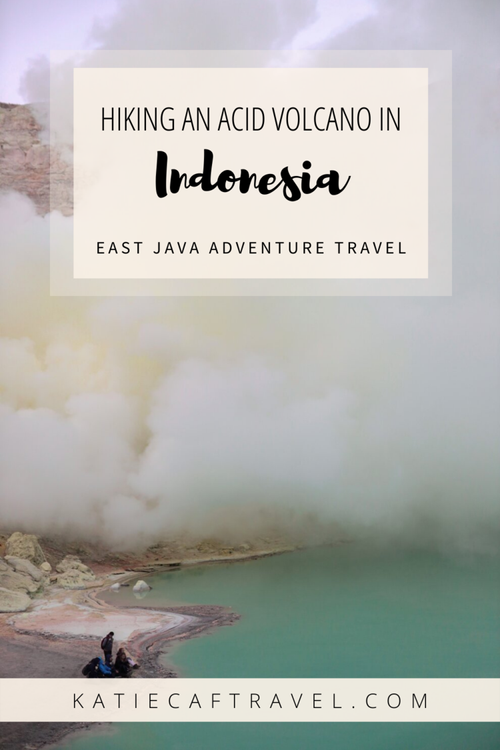
Mount Ijen is the world’s largest acidic volcano. Famous for its bright-turquoise blue crater lake, said to have a higher acidity concentration than battery acid, and fuming colorful yellow sulfur dotting the shores, Kawah Ijen is the most unique landscape in all of Indonesia. Typically visited on overnight treks in order to see the famous “Blue Fire” phenomenon, embarking on an overnight trek to Ijen’s crater is a true adventure in East Java.
✔️Mt Ijen Trek: Essential Info
- ⏳ Time: ALL night. Left at 1 am, returned to the hotel around 7 am
- 💸 Cost: about $50 pp from Licin (East Java), $100 pp from Bali.
- 🥾 Hike Difficulty: 1.5 – 3 hours for the hike up, and 1 – 2 hours for the hike down.
- 😷 You need to wear a gas mask to descend into the crater
- 🌋 Sometimes the crater is closed due to volcanic activity
- 🚕 You can take a cart taxi to the crater’s rim if you do not want to hike
- 👉 Tip: Come on a weekday if you can to avoid the crowds


What to Expect at Kawah Ijen
The Blue Fire
One of the reasons tourists flock to Kawah Ijen is because the volcano is one of the only places on earth you can witness “blue fire”. The blue flames are caused by naturally occurring sulfur being emitted from the earth and combusting as sulfur dioxide gas is formed. The blue flames burn 24/7 but can only be seen at night.

After finally reaching the bottom the tourists flocked to one specific area where the sulfur emerged and combusted, resulting in the famous “blue fire”. No one ever knows how much of a flame there will be, apparently, it used to be more pronounced. The flames are a product of the sulfur self-igniting and turning into sulfur dioxide gas.

It’s rumored that if there’s no blue flame the miners will light the gases themselves for the tourists. Even if it wasn’t as impressive as the photos I had seen online, it’s still an incredibly rare natural wonder and I was grateful for the experience.


Some tourists were pretty badly behaved in regards to the blue flame, we watched a family get so close to the 1,000-degree fire to practically burn their hands (and phones) off. Mt. Ijen is certainly a wild-west when it comes to safety protocol, everything from the sulfuric acid lake to the sulfuric acid fires (even the climb down) can kill you, you need to self-govern and be aware that it is, after all, an active volcano


An Active Sulfur Mine
Sulfur is called “Devil’s Gold” because of its yellow color and the extremely hazardous conditions associated with mining it. Kawah Ijen has been mined since 1968; everyday miners from the Banyuwangi region of East Java carry 150-200Lb baskets of sulfur from the smoke-filled crater of Kawah Ijen. The smoke is poisonous, and many miners work without gas masks. There have been multiple eruptions of the volcano where miners have allegedly been caught in the toxic gas clouds and perished. Kawah Ijen is one of the last sulfur mines in the world.

About the Miners
The sulfur miners (mostly) don’t wear gas masks, whether it’s because they don’t have them or because it impedes their production I cannot say. The miners seem to encourage tourists to take pictures of them, three times I was approached by a miner who saw me taking photos. A miner pointed to my camera, then pantomimed picking up his sulfur load with an exaggeratedly pained face, then said “Picture 15,000 rupiah” (about a dollar).

In lieu of a posed photograph, I gave the miner a small donation and he reached into his sulfur basket, which I was realizing served more as a prop bag, and took out a little seashell, perfectly whittled out of yellow sulfur.
👉 Consider Donating to the Miners: For every 150-200lb load of sulfur they bring out of the crater, they only earn about $5 USD. If you have the cash I would suggest donating to the miners, I’ve also heard about people bringing gifts of good, high-quality gas masks.

The Mountain “Taxis”
Another add-on service is the “TukTuk”, or mountain taxis. The mountain taxis are wheelbarrows that tourists who don’t feel like climbing up the mountain can use. Essentially you’re being pushed up the hill in a little cart. I found the practice pretty unnecessary since if you’re not fit enough for the incline up the dirt path, I’m not sure how you’d be fit enough for the steep descent into the crater (where TukTuks cannot go), but they seemed to do a lot of business!
Overall the TukTuk guys were pretty hilarious; we’d be huffing up a hill just to be passed by a skinny Indonesian man pushing a much larger foreign tourist in a cart like they were weightless. They also have a funny way of soliciting business. They’ll come up to a group of tourists hiking and say “Taxi?” And if they don’t respond, or if they say no (there are hundreds of TukTuk drivers soliciting) they’ll just say every synonym for taxi they know, ex: “Taxi?…. Gojek? Uber? Lyft? TukTuk?”

About the Hike
After passing through an arch where we handed in our entrance tickets, the dirt path leading up the mountain quickly became very very steep. We went on a busy Saturday so it felt kinda like a pilgrimage, with hundreds and hundreds of people making the ascent in a herd up the slope. On some weekends Kawah Ijen has more than 1,000 tourists per night. The number of people climbing that night turned out to be a blessing, there were no lights on the path, and the flashlights we rented hardly worked, everyone’s flashlight came together to light the path.

Descending Into the Crater
About two hours up, so maybe 3-4 am, we reached the peak of the crater and it started to level out. I became SO excited, but then quickly found out the slope turned into a line of people. The descent into the crater needs to be done one by one, in a single file line. There’s no clear path for the 300-meter descent; just a worn, windy, and narrow tread over piles and piles of scraggly rocks. It was pretty surreal to see hundreds of people with headlamps lined up to enter a smoke-filled pitch-black crater.

We patiently waited our turn in line for the descent, which easily took more than an hour. There was barely enough room for one person on the path, and I was shocked when the guides started motioning for the tourists to press up against the wall, and a sulfur miner emerged.
Carrying 150-200 lbs of sulfur on their back, the miners start working at 2 am to beat the daytime heat of the crater. Tourists are essentially in the way of the miners while they work. I’m surprised no one has developed a pull-levy system so the miners don’t have to carry each load by hand – but that’s what they do, and have been doing since the mine was developed in 1968.

Hiking Down the Next Morning
The descent down from Mount Ijen’s crater rim was surprisingly a lot more dangerous than the hike up. The reason is that the dirt path is very loosely packed. If you don’t have hiking shoes, you’re probably going to slip and slide down the incline at least once.
Funnily enough, this is when I considered hiring a TukTuk, on the descent. My shoes had gotten wet and weren’t gripping the earth at all, and we had just watched an older woman face-plant into the path. As I was about to give up, some French students ripped around the corner, high-intensity skipping, almost running down the mountain, yet none of them were falling. We took their hint and started running down the incline rather than cautiously walking, and we didn’t slip! At all!
🏃♀️ Running Downhill Vs. Walking: I think the higher impact our bodies were making into the loose dirt helped dig our heels in, so we managed to run down the mountain in half the time with zero falls.

Is Ijen Safe?
While Mt Ijen is open for tourism, it’s an incredibly hostile environment. Tourists are required to wear gas masks due to the active volcano constantly issuing sulfurous fumes. While the volcano last officially erupted in 1999, it is periodically closed to tourists for above-average volcanic activity. Furthermore, the lake in the crater of Kawah Ijen is the largest acidic lake in the world; the PH is said to be around 0, with the acidity stronger than that of battery acid.
How to Get to Mount Ijen Without A Tour
From Bali
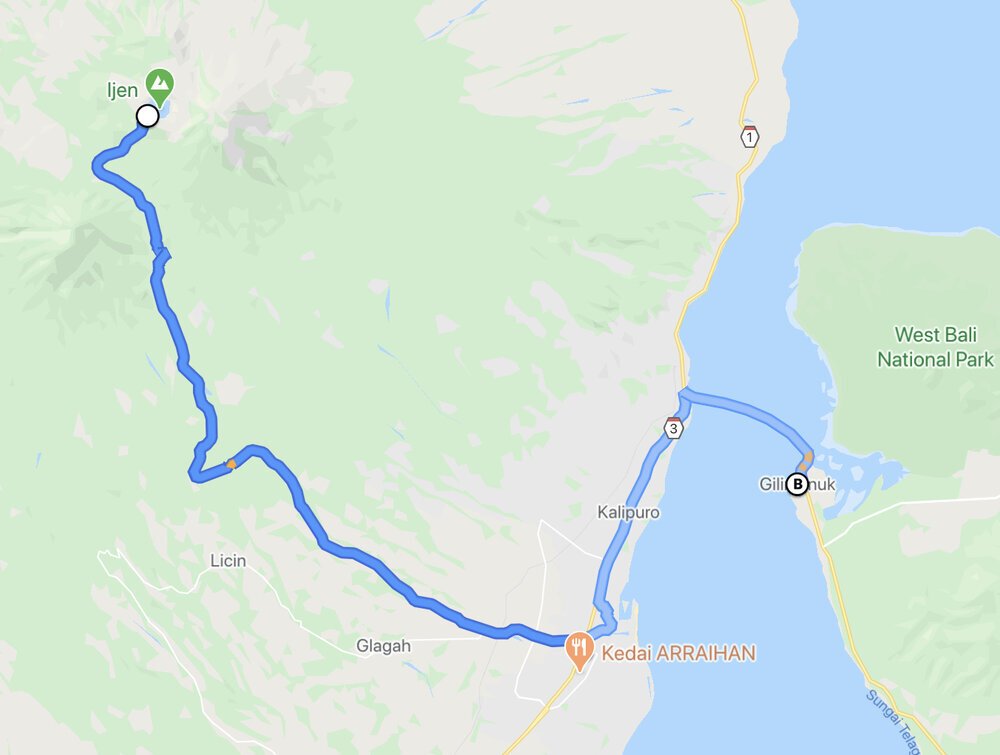
If you’re coming from Bali there are two options, one is a lot more expensive than the other. You could fly from Denpasar to Banyuwangi for a mere $500 USD on Hahn Air Systems (the only airline company that flies that route for under $1,000). Or, you can hire a car to take you to Gilimanuk Ferry Port in West Bali, and then take the ferry over to Ketapang Port in Java. Then hire another car to Kawah Ijen. This costs around $150 round trip. It’s a bit expensive, so I recommend finding some people to share the private cars with.
🚢 About the Ferry from Bali to Java: The ferry operates 24 hours a day every 15-20 minutes, it’s very pleasant and it has AC. If you have your own motor scooter or car, the ferries also do car transport.
From Malang
We took the train from Malang to Karangasem, which is a town close to Mount Ijen. A lot of tourists that go on programmed tours of Java go this route, starting west and visiting the sites heading eastward until they reach Kawah Ijen, and then hop over to Bali. The train we took from Malang is called the Tawang Alun 207, it runs every day between 4:05 and 11:34 pm from Malang to Karangasem.

💰How Much Does It Cost To Climb Mount Ijen Without A Tour
Booking transport through our hotel cost us 500,000 IDR ($35)per car, max 5 people. Our hotel was 22 USD, and gas masks (which are a must) and flashlights cost an additional 40,000 IDR ( $3 USD) to rent, but the flashlight we were given was really poor and I would recommend bringing your own. Tickets to enter Ijen for foreign tourists range from 100,000 IDR ($7 USD) to 150,000 IDR ($10 USD) if it’s a weekend.
👉 In total, it cost us around $85 for two people to climb Mount Ijen without a guided tour, and without any add-ons like taxi services, guides, or meals. We chose to buy hats, gloves, and snacks while on the hike, which made our overall close to $100 ($50 per person).
👉 Tip: Buy Hats & Gloves for the Hike: It’s freezing at that altitude at 2 AM. I think the gloves and hats were $5 each, so $10 altogether, is more than worth it!


FYI: Some links on my site are affiliate links that help support my site at no additional cost to you. Read more on my privacy policy page.
Mount Ijen Tours
We chose to climb Mount Ijen without a guided tour because we were coming from Java and going to Bali, and most guided tours are round-trip from the same location. If I was going to climb Mount Ijen again I would consider buying a tour package because they will arrange everything up-front. Also, while I enjoyed my tour and hotel very much, using a service with lots of good online reviews is recommended for this climb, since the gasmask and headlight we received on ours barely worked.

Kawah Ijen Tour From Bali
✔️ Includes All Transportation from Bali
✔️ Overnight Tour
✔️ Includes Entrance Fee
✔️ English Speaking Tour Guide

3-Day Tour Including Bromo & Ijen Volcanos!
✔️ Includes All Transportation + Accommodations
✔️ Visit Mount Bromo & Ijen Volcanos
Overnight Mount Ijen Tour From Banyuwangi
✔️ Perfect tour if you’re not going to Bali after your tour.
✔️ Includes transport from Banyuwangi Ferry port
✔️ Overnight Tour


What to Consider Packing
- Water: You might not feel thirsty because of the cold and altitude, but you should bring at least 2L per person of water for this hike. I’m crazy about hydration and always carry a 2L reusable water bottle.
- Hats & Gloves: It’s COLD up in Mount Ijen! I wasn’t prepared for how freezing it would be and actually had to buy hats and gloves on the mountain. Come prepared and bring your own cold-weather gear. Bonus, if you pack tech gloves you can take lots of photos without freezing your fingers!
- A good jacket: I always travel with my puffer coat but that wasn’t enough for Kawah Ijen! I recommend a puffer base + shell combo jacket. They pack down really well and last forever.
- A quality headlamp: The headlamp we rented at Kawah Ijen didn’t work at all! Now I always travel with a headlamp. They take up almost no room in your bag and come in handy in so many situations.
- A camera WITH flash: I brought my GoPro for our Ijen hike and when we got back the footage was unusable! You’re hiking mostly in the dark, so if you want to capture your moments make sure you have a camera with flash.
- A quality gasmask: The gasmask we rented at Ijen looked like it was from the 90s, and there was no way to check if the filter had ever been replaced. If you really want to be sure about your safety I would just bring my own gas mask for the climb.
- Hiking shoes with good grip: I totally regret trying to climb Ijen in sneakers! Not only did I wreck my new shoes, but I also fell on my bum about a dozen times on the hike down because my shoes had no grip! I recommend bringing some quality hiking shoes for the climb, or any shoes with good traction.
- A hiking pole: This is optional but on the way back down the earth was very slippery, a hiking pole would help if you really don’t want to fall on your bum. I use this travel hiking pole which is extremely light and packs down well.
📍Like this? Pin it for Later